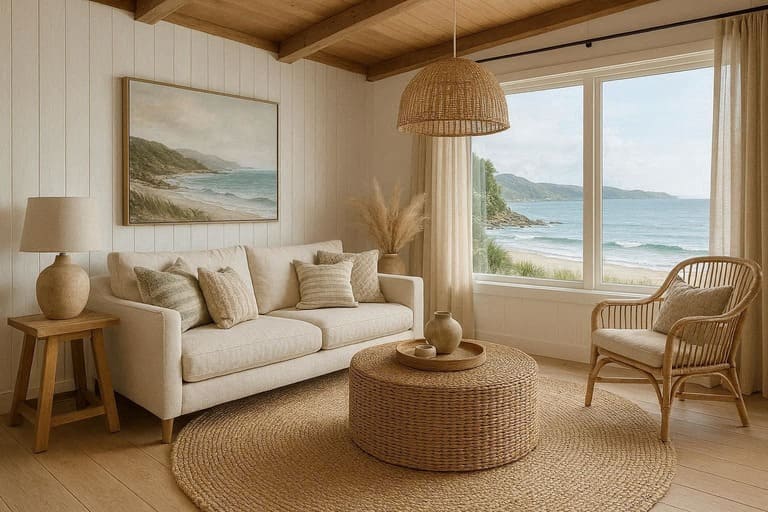
There’s a particular feeling that hits you when you walk into the right New Zealand bach. The light is soft. The air smells faintly of salt. A linen throw is draped over the couch, the timber floors are warm underfoot, and everything feels just relaxed enough that you immediately want to kick off your shoes.
That feeling — unhurried, honest, deeply connected to the coast — is what people are chasing when they talk about Kiwi coastal style. And the good news is that you don’t need to actually live 50 metres from the beach to recreate it. Whether you’re in a terrace house in Grey Lynn, a townhouse in Christchurch, or a suburban home in Tauranga, you can bring that breezy, sun-drenched quality indoors.
Here’s exactly how to do it — room by room, layer by layer, without falling into the tired nautical-cliché trap that many guides still recommend.
First: What Makes Kiwi Coastal Different?
Before diving into specifics, it’s worth understanding what separates New Zealand coastal style from the generic “coastal decor” you see on international Pinterest boards. Those rooms often lean heavily on Hamptons aesthetics — crisp navy and white, polished timber, highly styled and a little formal.
Kiwi coastal is something else entirely. It’s looser. More honest. Less like a magazine spread and more like a home where the surfboards actually get used.
It uses a base palette of whites, soft greys, and sandy beiges, accented with shades of blue and green — evoking the feeling of a breezy, sun-drenched bach that feels connected to the natural landscape. But what makes it distinctly Kiwi is the rougher edges: weathered timber, handmade ceramics, native plants, the odd piece of driftwood that someone actually picked up from an actual beach.
The goal isn’t a perfect room. It’s a room that feels like it belongs here.
1. Get the Colour Palette Right
The foundation of any coastal living room is the colour story, and getting it right is the difference between a space that feels genuinely coastal and one that just looks like it tried.
For a New Zealand coastal palette, think:
- Warm whites and soft off-whites as the dominant base — not crisp, cold white; something that has warmth to it, like Resene Triple Sea Fog or Dulux Natural White
- Sandy beiges and greige tones for secondary walls, furniture, or textiles
- Soft blue-greens — think the colour of Coromandel water on a calm day, or the haze off the Marlborough Sounds; dusty, muted, never electric
- Sage and olive greens that echo native bush rather than tropical palms
- Warm timber tones as a natural accent that runs through the whole room
What to avoid: the classic mistake is going too blue too fast. A living room that’s 70% blue and white looks like a Hamptons showroom, not a New Zealand home. Keep blue as an accent — cushions, a throw, a piece of art — and let warm neutrals do the heavy lifting.
One trick the best NZ coastal rooms use: introduce one earthy, warm tone that pulls the space back from feeling too “beachy.” A terracotta pot, a warm timber coffee table, or a dusty ochre cushion keeps the room grounded.
2. Natural Materials Are Non-Negotiable

If colour is the foundation, texture is the soul of a coastal living room. And in New Zealand specifically, the materials you choose should feel like they genuinely belong in this landscape.
The essential material palette:
- Timber — rimu, oak, or pine; raw, lightly oiled, or whitewashed; used in flooring, shelving, side tables, and frames
- Rattan and wicker — a rattan armchair or woven pendant shade is one of the most efficient coastal signifiers in any room
- Jute and seagrass — for rugs and baskets; these read as both coastal and grounded, which is exactly what you want
- Linen — on cushions, throws, and curtains; its natural drape and slight texture are far more honest than polyester blends
- Stone and ceramic — chunky handmade ceramics in sandy or grey-blue glazes; a stone or concrete side table
Coastal designs have evolved over the years — from collected seashells and bottled sand to clean lines and crisp contrasts. The minimalist coastal style offers a clean, modern approach to decorating your seaside home. But the Kiwi version takes it further by embracing imperfection. A handthrown ceramic bowl that’s slightly uneven is more interesting than a perfect factory-made one. A piece of driftwood used as a shelf bracket tells a better story than a polished timber bracket.
Mix smooth with rough, hard with soft, polished with raw. That contrast is where the texture magic happens.
3. Light: The Element Everyone Underestimates
New Zealand’s coastal light is extraordinary — warm and bright in the north, softer and more diffused in the south. A coastal living room that doesn’t work with that light is missing its most powerful asset.
Maximising natural light:
- Keep window treatments light and sheer — linen curtains that billow slightly rather than heavy drapes
- Use mirrors strategically to bounce light around the room, especially in south-facing rooms that get less direct sun
- Choose furniture in lighter tones so the room doesn’t absorb all that beautiful natural light
- Keep windowsills and areas near windows clear of clutter
Artificial lighting for evenings:
This is where coastal rooms often fall down. A single overhead light strips the warmth out of everything you’ve carefully created during the day. Layer your lighting:
- A statement pendant in rattan, woven hemp, or natural linen over the main seating area
- Floor lamps with warm-toned shades in reading corners
- Table lamps on side tables and shelves
- Warm candles — actual candles, not fake LED ones — for evenings when the room should feel like the best bach you’ve ever stayed in
Always use warm white bulbs (2700–3000K). This single change, if you haven’t already made it, will transform your living room more than almost anything else.
4. Furniture: Choose Comfort Over Perfection
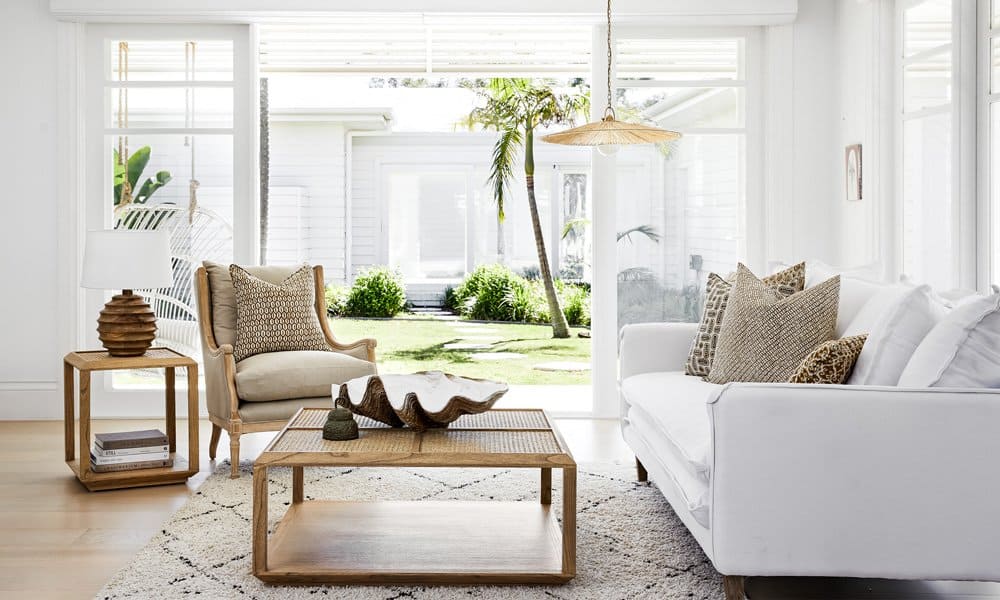
Coastal living rooms should look like they’re used. Heavily. With sandy feet and salty hair and no anxiety about ruining anything.
That means furniture choices matter — not just aesthetically, but practically.
What works:
- Deep, squishy sofas in linen, cotton canvas, or natural-look fabric; slipcovers are genuinely brilliant in coastal rooms because they can be washed when the inevitable happens
- A low coffee table — timber, stone, or rattan; low and casual reads as more relaxed than a tall, formal table
- Mismatched seating — a rattan armchair alongside an upholstered sofa is far more interesting than a matching suite; it looks collected, not ordered
- Natural fibre rugs — a large jute or wool rug anchors the seating area and adds warmth underfoot
- Simple, honest shelving — floating timber shelves styled with books, ceramics, and a few meaningful objects
What to avoid:
- Leather sofas (they feel wrong in a coastal room and are cold in winter — a Kiwi coastal room should be warm year-round)
- Very dark, heavy furniture that eats light
- Anything too formal or polished — it fights the relaxed energy you’re trying to create
5. Plants: Bring the Outside In
No coastal Kiwi living room is complete without greenery, and in New Zealand we have the most interesting options in the world.
Adding indoor plants introduces a pop of vibrant colour and life, contrasting beautifully with the neutral backdrop — and for a coastal room, the type of plant matters as much as the plant itself.
Plants that feel right in a NZ coastal room:
- Flax (harakeke) — dramatic, architectural, deeply local; a statement pot of flax in a corner is pure New Zealand
- Pōhutukawa-inspired shapes — spiky, sculptural plants that echo coastal native vegetation
- Trailing plants on shelves (pothos, devil’s ivy) that add softness and movement
- Succulents and coastal grasses in sandy ceramic pots
- Large-leafed tropicals (monstera, bird of paradise) for warmth and life
Put plants in beautiful pots — this is where the investment pays off. A $12 pothos in a $40 handthrown ceramic pot looks significantly better than a $40 plant in a cheap plastic nursery container.
6. Styling the Details: Avoid the Clichés
This is where most coastal living rooms go wrong. The internet is full of coastal styling that leans on anchors, ropes, ship wheels, and mass-produced shells from a homeware chain. That’s not Kiwi coastal. That’s a themed restaurant.
The styling details that actually work:
- Real objects from real places — a piece of driftwood from Raglan beach, a smooth stone from the Abel Tasman, a shell found on the Kapiti Coast; these mean something and look like it
- Local art — a print or original piece by a New Zealand artist that references the coast, landscape, or ocean; support a local printmaker rather than buying a generic “beach” print from a chain store
- Handmade ceramics in sandy, blue-grey, or ocean-influenced glazes; a ceramics market or Felt NZ will have something genuinely beautiful
- Books and natural objects on shelves — styled loosely, not obsessively; stacks of coffee table books alongside driftwood and ceramics look collected and real
- Woven baskets for storage; they’re practical and they look like they belong
The guiding principle: every object in a coastal room should either be useful, beautiful, or genuinely meaningful. Anything that’s just “coastal themed” should go.
7. The Indoor-Outdoor Connection
Perhaps the most uniquely Kiwi element of all: the indoor-outdoor flow. New Zealand homes — especially coastal ones — have always been designed with permeable boundaries between inside and out.
The outdoor kitchen has become part of the interior even though it’s exterior — sometimes the indoor and outdoor areas are only divided by a wall, with bifold or sliding doors making it look like the inside keeps going through.
Even if you’re not in a position to renovate, you can create that feeling:
- Position your living room furniture so it faces a window or door with a view or garden aspect
- Keep the transition between inside and outside visually light — avoid heavy curtains or solid furniture blocking sightlines to the outdoors
- Bring outdoor materials inside (timber, stone, woven textures) so the language of both spaces is consistent
- If you have a deck or small outdoor area adjacent to the living room, style it with the same palette — it makes both spaces feel larger and more connected
Putting It All Together
The Kiwi coastal living room is not a formula you apply. It’s a feeling you build towards, gradually, with choices that feel honest to where you live and how you actually use the space.
Start with the foundation: warm neutral walls, natural timber, linen soft furnishings. Layer in texture — jute rug, rattan chair, handmade ceramics. Add light — sheer curtains, layered lamps, warm bulbs. Introduce greenery. Style with real objects rather than bought “coastal” props.
Then stop before it’s finished. The best coastal rooms always have a little space left — room for the next beautiful thing you find at a market, the shell your kid picks up on the next beach walk, the print you’ll fall in love with at the next local arts sale.
That unfinished quality is what makes it feel real. And real is what Kiwi coastal style has always been about.